





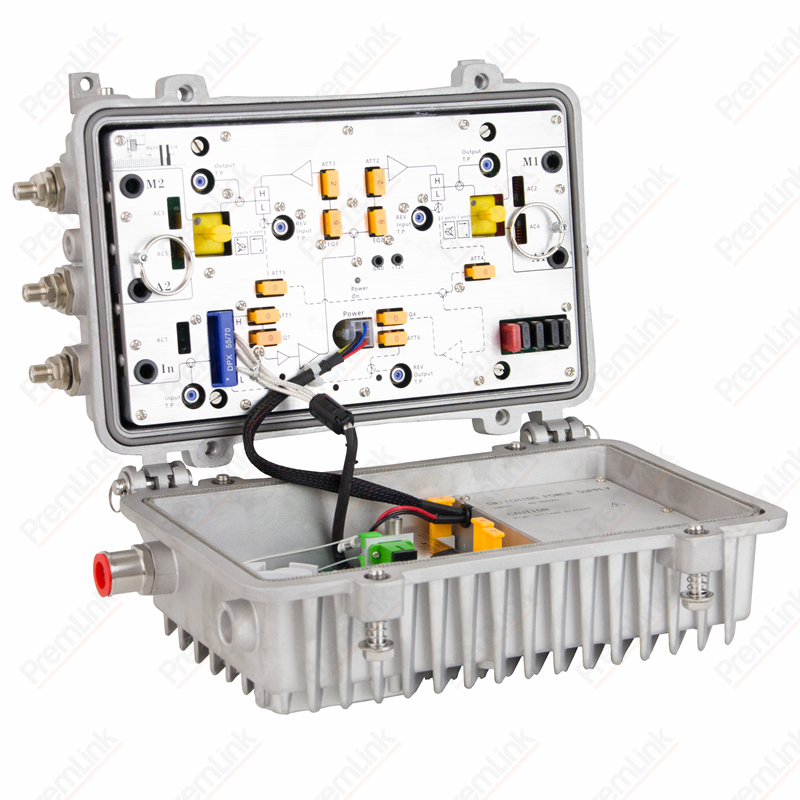
Product Overview
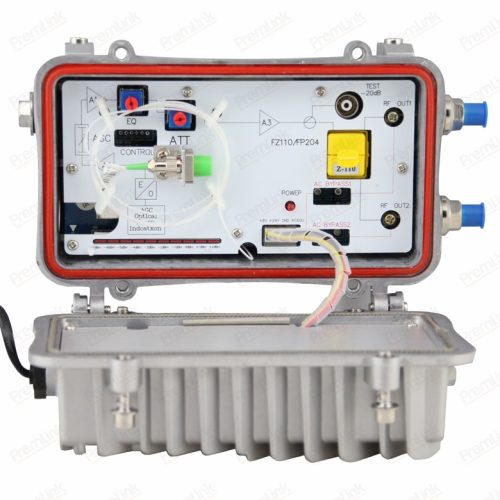
The PL3000A optical segmentable node is designed for fiber-deep HFC networks. It has two high-level RF output ports. Each high level RF output port can be divided into two low-level output ports. All attenuation and equalization modifications will be made with ordinary JXP type pads.
PL3000A optical segmentable node’s reverse traffic can be mixed and routed using a DFB return transmitter module. Bi-directional TPs allow the operator to monitor and inject through a single TP connection. PL3000A optical segmentable node’s will be able to upgrade from a PL3100A amplifier to an optical node. This type of segmentable node will be field upgradeable from a forward-only to a forward-return path product.
PL3000A optical segmentable node’s is adaptable to unique network requirements due to the use of selectable optical connectors, strand mounting, and international frequency split.
Specifications
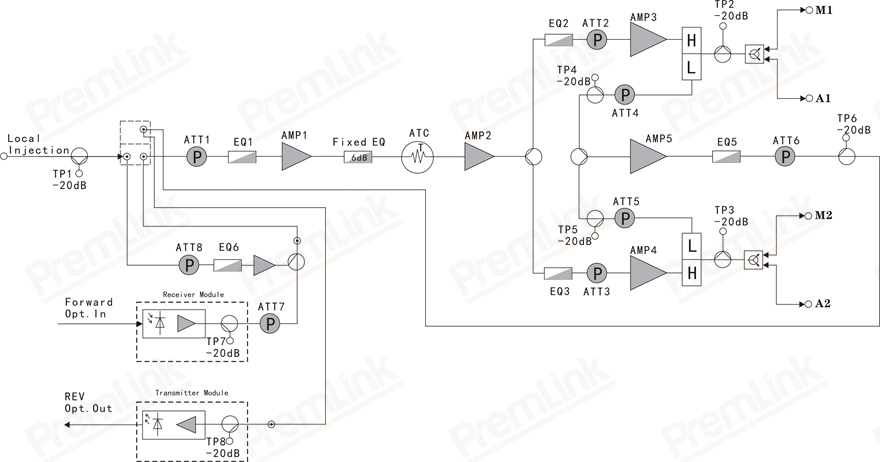
Block Diagram
Forward Optical Receiver Characteristics
| Parameter | Unit | Value | Remark |
| Optical wavelength | nm | 1310 | 1200 to 1610nm |
| Optical connector | / | SC/APC
FC/APC |
Configured at Factory |
| Optical Responsivity | A/W | ≥0.85 | @1310nm |
| Optical return loss | dB | ≥40 | |
| Optical operating range | dBm | -8dBm ~ +2 | |
| Optical AGC range | dBm | -4dBm ~ +2 | |
| Optical AGC control stability | dB | ±1.5 | @-40℃~+60℃.Output level is maintained and Flatness is ±0.75dB for normal optical input power levels |
| Maximum Rx Input Power | dBm | +10 | Max level without damaging photo diode |
| EIN | pA/rtHz | ≤8 |
Forward RF Characteristics
| Parameter | Unit | Value | Remark |
| Frequency Range | MHz | 54 ~ 1200 | Different split is available |
| RF output level | dBmV | 50 | 2 ports Version |
| dBmV | 46.5 | 4 ports Version | |
| Internal Tilt | dB | 17±1 | @1200MHz |
| Flatness | dB | ±0.75 | -40℃ ~ +60℃ |
| Output Return Loss | dB | ≥16 | |
| RF Connector | / | 5/8” or PG11 | Exchangeable |
| RF Output TP | dB | -20±1 (w/jmpr) | Relative to RF output port, TP is F-female type connector |
| dB | -16.5±1(w/spltr) | ||
| Test Point Flatness | dB | ±0.75 | 2 ports Version |
| dB | ±1 | 4 ports Version | |
| Test Point Return Loss | dB | ≥16 | |
| Isolation(FWD/REV) | dB | ≥46 | In band, Local Injection input downstream RF and test at REV Input TPs. |
| Distortion Test Condition: RF output | dBmV | 50 | 2 ports version |
| dBmV | 46.5 | 4 ports version | |
| Distortion Test Condition: Tilt | dB | 17±1 | @1200MHz |
| CTB | dBc | 67 | 59NTS, COIP -3dBm, OMI 3.25%, 110dBuV@550MHz, w/o fiber spool |
| CSO | dBc | 65 | |
| Cross Modulation | dBc | 62 | 59NTS+QAM, COIP -3dBm, OMI 3.25%, 110dBuV@550MHz, w/o fiber spool |
| Noise Figure | dB | £ 9 | |
| HUM | dB | 65 | @10A |
Return RF Characteristics
| Parameter | Unit | Value | Remark |
| Frequency Range | MHz | 5 ~ 42 | Different split is available |
| Gain | dB | 23 | Without 3-state switch |
| Flatness Reverse | dB | ±0.75 | |
| Internal Reverse Tilt | dB | 0 | ±0.5dB |
| Noise Figure | £ 10dB | ||
| Input Test Point | dB | -20 (w/jumper) | Relative to RF input port, ±1dB margin,
TP is F-female type connector |
| dB | -23.5 (w/splitter) | ||
| TP Flatness | dB | ±1.0 | |
| Reverse Return Loss | dB | ≥16 | |
| HUM | dB | 65 | @10A, Using the Matrix method |
| Operating input Level Range | dBmV | 20 | Typica, 6 CHs bonding |
Return Optical Transmitter Characteristics
| Parameter | Unit | Value | Remark |
| Optical Output Power | dBm | 3 | DFB laser |
| Optical Wavelength | nm | 1470~1610 | CWDM |
| RF Drive Level | dBmV | 5~20 | |
| Optical Connector | / | SC/APC | FC/APC optional |
| NPR | dB | 25@30dB | 1550nm CWDM |
| Test Point | dB | -20 | 20dBmV@10%OMI |
General Characteristics
| Parameter | Unit | Value | Remark |
| Working Temperature | ℃ | -40 ~ +60 | |
| Storage Temperature | ℃ | -40 ~ +85 | |
| Output Ports | / | 2 or 4 | with splitter |
| Surge | kV | ±6 | IEEE C62.41, 1.2/50uS Combination Wave |
| Forward Equalizers | / | Plug-in(with JXP ATT) | |
| Return Equalizers | / | Plug-in(with JXP ATT) | Will be built based on different frequency split |
| Thermal Compensation | / | Yes | Built on board |
| AC Input Voltage | VAC | 40 to 90 | Line Powered |
| Efficiency | % | >80 | |
| Power Consumption | W | ≤35 | With Rx & Tx module |
| Power Passing | A | 10 or 15 exchangeable | 15A or 20A for 2 Hours@60°C no degradation is required for 10A or 15A respectively. |
| Water & Dust Resistance | / | IP68 | |
| Housing Dimensions | mm | 333*208*136 | Strand outdoor housing |
| Packaging Carton | mm | 370*270*220 | |
| Weight | 6.2Kg |
Welcome to enquiry our PL3000A optical segmentable node.
PL3000A: High-Output Optical Segmentable Node for Fiber-Deep HFC
The high-density, field-upgradeable segmentable node designed for bi-directional 1.2GHz broadband networks.
- Advanced Segmentation: Support for forward and return path segmentation, allowing operators to increase bandwidth capacity without laying new fiber.
- High RF Output Performance: Delivers 110dBµV output level (2-port version) using premium GaAs technology for superior linearity.
- 1.2GHz Future-Proofing: Extended frequency range up to 1218MHz, making it fully compatible with DOCSIS 3.1 and future network upgrades.
- Field-Upgradeable Design: Easily converts from a standard amplifier to an optical segmentable node, supporting modular DFB return transmitters.
- Industrial Ruggedness: Encased in an IP68-rated strand-mount housing with ±6kV surge protection for reliable outdoor operation in extreme climates.
Technical FAQ: PL3000A Segmentable Node
Q1: What are the benefits of using a segmentable node in HFC networks?
A: A segmentable node like the PL3000A allows you to split a single optical node into multiple independent RF segments. This effectively reduces the “service group” size, increasing the available per-user bandwidth for high-speed data and VOD services without extensive re-cabling.
Q2: Does the PL3000A support bi-directional traffic monitoring?
A: Yes. It features bi-directional Test Points (TPs), enabling operators to monitor and inject signals through a single connection point. This drastically simplifies field maintenance and network balancing for return path traffic.
Q3: How is the output level managed across different temperatures?
A: The PL3000A is equipped with Thermal Compensation on-board and supports both MGC and AGC modes. This ensures the 110dBµV output level remains stable within ±1.5dB even during extreme outdoor temperature fluctuations from -40℃ to +60℃.
Q4: Can this node be upgraded from an existing amplifier?
A: Absolutely. Our modular architecture allows for a seamless field upgrade from a PL3100A amplifier to a full-featured optical node by adding receiver and transmitter modules, protecting your initial infrastructure investment.
Planning a 10G-PON Migration?
If your network is transitioning from HFC to FTTH, check our
High-Power XGSPON EDFA Series
to combine CATV overlay with 10G-PON data on a single fiber link.