


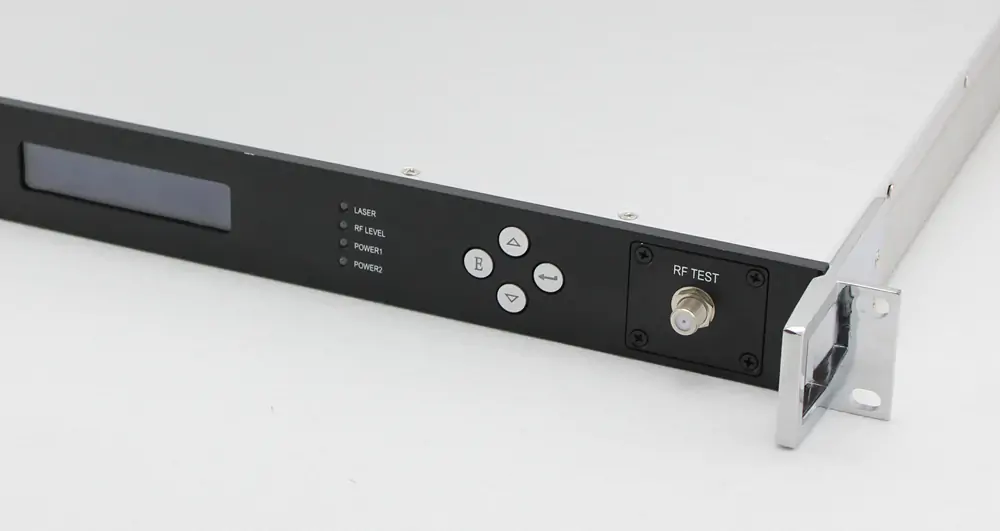
The short version: Choosing an optical transmitter for a CATV/HFC network comes down to three calls—wavelength (1310 vs 1550 nm), modulation (direct vs external, which sets your reach), and output power sizing (which sets how many nodes you can feed). 1310 nm direct modulation is cheap and fine up to roughly 20 km. 1550 nm direct is the compromise, but hits a dispersion wall. 1550 nm external modulation is the expensive option that reaches 65 km+ and holds CTB/CSO best—the call for long haul and heavy splitting. On output, every 3 dB roughly doubles what you can support. Premlink’s PL series spans all three: PL1310A (6–24 mW / 1310), PL1550A (6–12 mW / 1550 direct), PL1550T (dual-port 7–10 dBm / 1550 external).
Start with reach, not the datasheet
The first cut in transmitter selection has nothing to do with a spec table—it’s your link length.
| Link length | First choice | Why |
|---|---|---|
| ≤ 12–15 km | 1310 nm direct | Cheapest; dispersion is a non-issue |
| 15–25 km | 1550 nm direct | Cheap and workable, but nearing the dispersion wall |
| >25 km (or heavy splitting) | 1550 nm external | Lighter dispersion + narrow-linewidth laser; holds CTB at distance |
Why does length decide modulation? Dispersion differs by wavelength. Near 1310 nm dispersion is close to zero, so direct modulation there pays almost no penalty. At 1550 nm the dispersion coefficient is higher, and a directly modulated laser’s chirp accumulates into degradation over distance. To reach far you need external modulation—a narrow-linewidth source plus an external modulator that suppresses that chirp. That’s the technical reason external 1550 units can cover 65 km+ while direct units struggle.
Sizing output: dBm vs mW and when it’s “enough”
Transmitter power is usually marked in dBm (logarithmic) or mW (linear). Selection errors live right here, so two anchors:
- 0 dBm ≈ 1 mW
- Doubling power = +3 dBm (halving = -3 dBm)
– 0 dBm ≈ 1 mW
– Doubling power = +3 dBm (halving = -3 dBm)
Premlink’s three-tier real output (from the product pages):
| Model | Wavelength | Modulation | Output | Typical role |
|---|---|---|---|---|
| PL1310A | 1310±10 nm | Direct | 6–24 mW (~8–14 dBm) | Short link, near metro nodes |
| PL1550A | 1550±10 nm | Direct | 6–12 mW (~8–11 dBm) | ≤20 km medium link |
| PL1550T | 1540–1563 nm | External | Dual port, 7/8/9/10 dBm per port | Long 65 km+, heavy split, dual-path backup |
The judgment formula: node received power = launch power − fiber loss (~0.35–0.4 dB/km @1550) − split loss − connector/splice loss.
Worked example (external PL1550T, 10 dBm per port):
- Node needs ≥0 dBm;
- 65 km fiber ≈ 65 × 0.35 ≈ -23 dB;
- split/connector reserve ≈ -5 dB;
- margin ≈ 10 − 23 − 5 = -18 dB—not enough on its own.
– Node needs ≥0 dBm;
– 65 km fiber ≈ 65 × 0.35 ≈ -23 dB;
– split/connector reserve ≈ -5 dB;
– margin ≈ 10 − 23 − 5 = -18 dB—not enough on its own.
So 65 km is “passive direct + low margin” territory, not something a single 10 dBm port carries with room to spare. Real deployments pair it with an EDFA or intermediate amplification. What actually decides “enough” is your split ratio and node distance, not the transmitter number. Do the budget, don’t stare at the power column.
Bottom line: bigger output isn’t automatically better. Too much power from an externally modulated unit triggers SBS (stimulated Brillouin scattering), reflecting power back into the laser and causing distortion. The PL1550T suppresses SBS (adjustable around 13–19 dBm) to keep this in check. It’s exactly why direct units can push power freely while external units have to throttle it.
Reading the three key specs: CNR, CTB, CSO
The trio that describes transmitter quality. Get the direction right:
- CNR: higher is better (≥51 dB is the floor; external reaches ≥53 dB)
- CTB, CSO: more negative is better (less 2nd/3rd-order distortion)
– CNR: higher is better (≥51 dB is the floor; external reaches ≥53 dB)
– CTB, CSO: more negative is better (less 2nd/3rd-order distortion)
| Spec | PL1310A / PL1550A (direct) | PL1550T (external) |
|---|---|---|
| CNR | ≥51 dB | ≥53 dB |
| CSO | ≤ -60 dBc | ≥65 dB (same meaning, cleaner) |
| CTB | ≤ -65 dBc | ≥65 dB |
External keeps CTB/CSO better at distance because the source is cleaner and the pre-distortion is more complete. That’s why long links need external—not just for reach, but for a picture that doesn’t degrade at the far end.
The field details that bite hardest
- Connectors: SC/APC or FC/APC (Premlink ships APC as standard to block reflection). Don’t run UPC straight into a transmitter—insufficient return loss reflects back into the laser, degrading performance and risking damage.
- Clean end-faces before plugging in. A dirty face can add 3 dB+ loss, effectively throwing away half your power.
- RF input level matters. Too high over-modulates and CTB worsens; too low and CNR drops. Premlink direct units have built-in AGC to smooth input fluctuations—one reason they sit more stably behind a combiner.
– Connectors: SC/APC or FC/APC (Premlink ships APC as standard to block reflection). Don’t run UPC straight into a transmitter—insufficient return loss reflects back into the laser, degrading performance and risking damage.
– Clean end-faces before plugging in. A dirty face can add 3 dB+ loss, effectively throwing away half your power.
– RF input level matters. Too high over-modulates and CTB worsens; too low and CNR drops. Premlink direct units have built-in AGC to smooth input fluctuations—one reason they sit more stably behind a combiner.
Which one do you actually buy
1. Near-metro, tight budget → PL1310A (1310 direct, best value)
2. Single-fiber GPON coexistence, medium reach → 1550 direct PL1550A (1550 doesn’t occupy the PON upstream at 1310; coexists on the same fiber)
3. Long reach, heavy splitting, dual-path/backup, max picture quality → PL1550T (external, dual port)
4. Unsure about your link loss → run the budget sheet first, then pick the tier. Don’t pick off the power number.
Recommended reading
- Premlink CATV Optical Transmitter — series overview and 1310 vs 1550 guide
- Specific models: PL1310 1310nm, PL1550 1550nm, External modulation
– Premlink CATV Optical Transmitter — series overview and 1310 vs 1550 guide
– Specific models: PL1310 1310nm, PL1550 1550nm, External modulation
FAQ
Q: What’s the real difference, and the price gap, between 1310 and 1550?
A: 1310 direct is cheap and dispersion-tolerant but short-reach and eats the PON upstream wavelength at 1310. 1550 favors reach and GPON coexistence. Price: 1550 direct sits close to 1310 direct (slightly more for the laser source); 1550 external is clearly above both. Short and cheap to 1310, long or coexistence to 1550.
Q: Can a direct unit reach beyond 20 km?
A: Physically yes, but the far end’s CTB degrades and picture quality drops. For clean video beyond ~25 km, use external modulation—don’t push a direct unit that far.
Q: Why does the external unit’s power look “smaller” in dBm?
A: Because external units are SBS-sensitive—too much power creates distortion. Their value isn’t a big per-port number; it’s narrow linewidth, low distortion, and reach. A direct unit may show higher dBm but that edge decays fast at distance.
Q: What’s the dual-port PL1550T for?
A: One port for the main link, one for backup or fan-out to a second area. It removes a single point of failure at the device level and can save buying a spare unit.
*Target keywords: catv optical transmitter / catv fiber optic transmitter. Written for HFC/FTTH network planners and engineers.*