






Product Overview
PL8130A CATV RF Line Extender is an amplifier used in cable television systems. Its primary role is to compensate for signal loss caused by cables, hence increasing the distance of signal transmission on branch lines. This type of line extender amplifier is typically built in the circuit beside the trunk amplifier to ensure that the signal can cover a larger region, reduce signal loss, and increase the transmission distance of network signals.
PL8130A CATV RF amplifier is a small type of Line Extender that is applied for HFC network.
Block Diagram
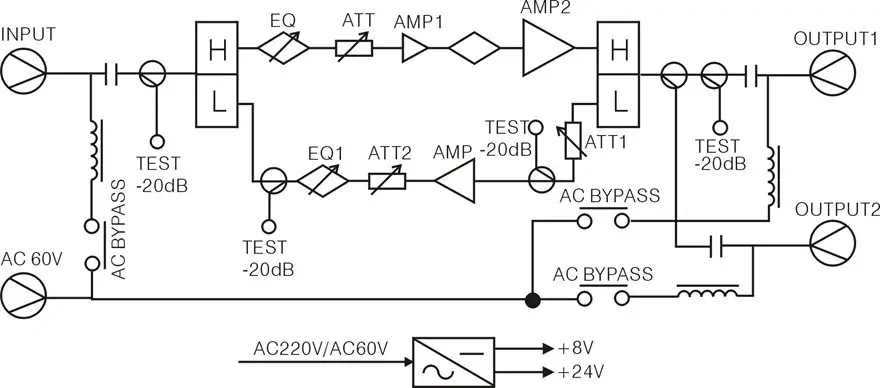
PL8138A Line Extender Amplifier
Functional Explanation
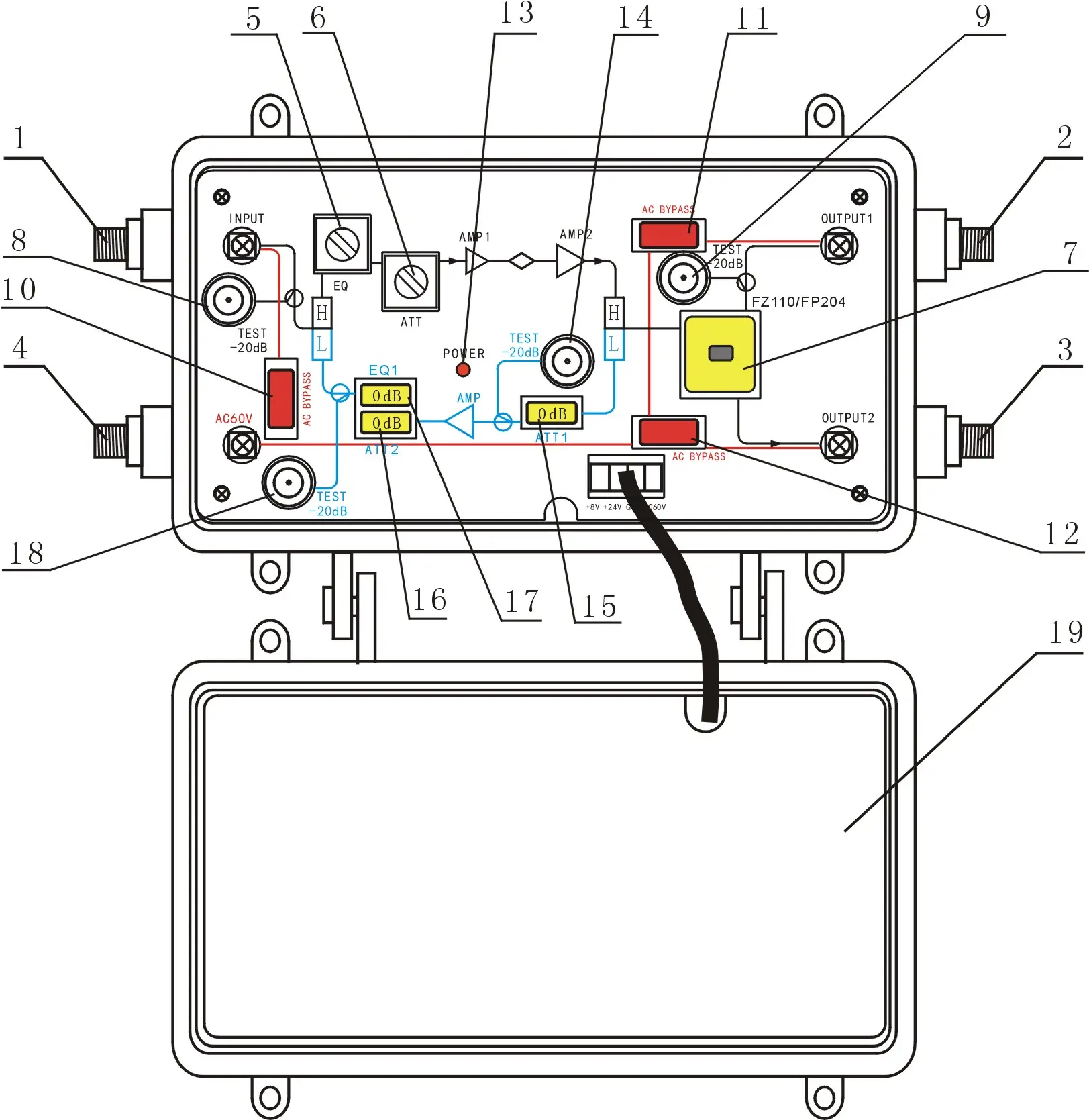
| NO. | Description | NO. | Description |
| 1 | Forward Input | 11 | Output 1 Feeding Plug |
| 2 | Forward Output 1 | 12 | Output 2 Feeding Plug |
| 3 | Forward Output 2 | 13 | Power Supply Indicator |
| 4 | AC60V Input (Optional) | 14 | Return Input Test Port |
| 5 | Forward Signal Attenuator | 15 | Return Input Attenuator |
| 6 | Forward Signal Equalizer | 16 | Return Output Attenuator |
| 7 | Tap / Splitter Plug | 17 | Return Output Equalizer |
| 8 | Forward Input Test Port | 18 | Return Output Test Port |
| 9 | Forward Output Test Port | 19 | Power Supply |
| 10 | Input Feeding Plug |
Specifications
Forward Path
| Parameter | Unit | Value |
| Working Frequency | MHz | 87~1000 |
| Working Gain | dB | 26~30 |
| Gain Adjustable Range | dB | 0~20 |
| In-band Flatness | dB | ±0.5 |
| Input Level | dBμV | >72 |
| Output Level | dBμV | 98/102 |
| Noise Figure | dB | ≤8 |
| CSO | dB | 70/66 |
| CTB | dB | 75/67 |
Return Path
| Parameter | Unit | Value |
| Working Frequency | MHz | 5~65 |
| Working Gain | dB | 0~20 |
| Gain Adjustable Range | dB | 0~20 |
| In-band Flatness | dB | ±0.5 |
| Input Level | dBμV | >75 |
| Output Level | dBμV | 90/96 |
| Noise Figure | dB | ≤8 |
Others
| Parameter | Unit | Value |
| Input/Output Return Loss | dB | ≥16 |
| Carrier to AC Ratio | dB | ≥66 |
| Resist Shock Voltage | KV | 5(10/700μS) |
| Power Supply | V | 60/220 |
| Dimension | mm | 220(L)* 140(W) * 100(H) |
Welcome to enquiry our PL8130A CATV RF Amplifier.
PL8130A: 1GHz Bi-Directional CATV Line Extender for Branch Compensation
A compact, high-efficiency RF amplifier engineered to neutralize cable attenuation in branch lines, ensuring peak signal integrity across expansive HFC network footprints.
- Branch Amplification: The PL8130A line extender is specifically designed to sit downstream of trunk amplifiers, providing a steady 26dB to 30dB gain to boost signals across high-loss coaxial branch segments.
- 1GHz Frequency Support: Operating within the 5MHz to 1002MHz broadband spectrum, it fully supports high-definition digital channel lineups while maintaining a low noise figure (≤8dB) for crystal-clear subscriber reception.
- Advanced Bi-Directional Logic: Featuring a robust return path (5-65MHz), this line extender facilitates seamless upstream data flow for DOCSIS modems and interactive Set-Top Boxes, essential for modern high-speed internet services.
- High Reliability: Encased in a weather-resistant housing with 5kV (10/700μS) surge protection, the PL8130A handles volatile outdoor conditions while offering flexible power options (60V line-powered or 220V mains).
- Optimized Signal Conditioning: Independent gain and tilt adjustments (0-20dB) allow technicians to perfectly balance the output level (up to 102dBμV), preventing over-driving and maintaining superior CTB (≥75dB) performance.
Technical FAQ: CATV Line Extender
Q1: What is the primary function of a line extender in a CATV plant?
A: The line extender acts as a strategic relay station. Its primary role is to compensate for the progressive signal loss caused by long coaxial cable runs. By boosting the RF levels on branch lines, it allows the network to cover larger geographical regions without degrading service quality for end-users.
Q2: How does the PL8130A handle bi-directional data traffic?
A: This line extender features a split-band architecture. The forward path (87-1000MHz) carries downstream television and data, while the return path (5-65MHz) handles upstream communication from the home back to the headend, ensuring full compatibility with interactive HFC network requirements.
Q3: Why is the compact size of the PL8130A an advantage for installers?
A: Field deployments often involve tight spaces on poles or in pedestals. The compact dimensions of the PL8130A line extender allow for easier installation in congested areas, while the integrated test points enable technicians to measure signal levels without opening the housing, speeding up maintenance cycles.
Scaling Your HFC Infrastructure?
If you need higher output capacity or a field-upgradable path to an optical node, check our
PL3100A Outdoor Broadband Amplifiers
for trunk-level performance.


