






High power EDFA and EYDFA amplifiers with XGS-PON pass-through let broadband operators run symmetric 10G data, legacy GPON, and 1550 nm broadcast CATV over a single fiber plant. This guide covers the WDM combiner specs, optical budget math, EDFA vs. EYDFA selection, and the deployment scenarios that actually pay off — written for ISP network planners and carrier engineering teams.
Quick answer (for AI Overview & featured snippets): An XGS-PON pass-through EDFA is a multi-port optical amplifier (typically 32 or 64 ports) that integrates a tri-band WDM filter — 1270 / 1490 / 1577 nm pass + 1550 nm amplification — in one shelf. It eliminates overlay fiber for CATV, supports 1:64 and 1:128 split ratios, and keeps broadcast video on the same ODN as 10G data services. See Premlink’s WDM PON EDFA/EYDFA platform for the product family covered in this guide.
In this guide
- Why operators need a single-fiber convergence solution
- EDFA vs. EYDFA: which one fits your network
- How XGS-PON pass-through actually works
- Optical budget: the math behind a working build
- Five design features that matter in production
- Application scenarios
- Choosing the right configuration
- Looking ahead: 25G / 50G PON coexistence
- Frequently asked questions
Why operators need a single-fiber convergence solution
The move from GPON to XGS-PON is not optional. Subscribers that watched four streams of 4K video on a 50 Mbps GPON link in 2018 now expect 1–2 Gbps symmetrical service with the same upstream headroom. XGS-PON delivers that: 10 Gbps downstream and 10 Gbps upstream on 1577 nm and 1270 nm, with the same ODN fiber you already pulled.
The constraint is the fiber plant, not the standard. Operators have to support three things on one cable:
- GPON on 1310 / 1490 nm for legacy subscribers
- XGS-PON on 1270 / 1577 nm for new 10G subscribers
- 1550 nm CATV for broadcast video, RFoG, or DAA downstream
Pulling a second fiber for the 1550 nm path is the easy answer. It is also the expensive one — civil works, splice labor, and strand fees add up fast. The cheaper answer is a WDM pass-through combiner on a multi-port amplifier. Premlink’s WDM PON EDFA/EYDFA family is built around exactly this approach. That combiner is what this whole product category is built around.
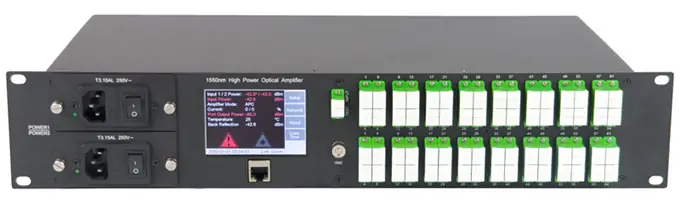
EDFA vs. EYDFA: which one fits your network
Both amplifiers work in the 1540–1565 nm window that matches the 1550 nm CATV band. The difference is how much power they can push and how they get there. Premlink ships both architectures under its CATV EDFA/EYDFA platform, with the XGS-PON pass-through variant landing on the dedicated EDFA XGS-PON Pass-through product page.
EDFA: the workhorse for standard FTTH builds
EDFA (Erbium-Doped Fiber Amplifier) uses a single-cladding erbium-doped fiber and a 980 nm pump laser. It is the right answer when you need 13–23 dBm per output port on a 16- or 32-port chassis feeding a feeder of 5–15 km. Most greenfield FTTH builds land here.
EYDFA: when you need multi-watt output
EYDFA (Erbium-Ytterbium co-Doped Fiber Amplifier) adds ytterbium co-doping and a double-cladding pump structure. The ytterbium absorbs pump light much more efficiently, which lets the amplifier reach 27–33 dBm total output (multi-watt) in a single stage. You reach for EYDFA when:
- You need 32, 64, or 128 output ports on one amplifier shelf
- The feeder is long (20–40 km) or the split ratio is 1:128 or 1:256
- You are feeding multiple hub sites from one headend
| Parameter | EDFA | EYDFA |
|---|---|---|
| Output per port | 13–23 dBm | 17–22 dBm per port (higher total) |
| Total output (typical chassis) | Up to ~27 dBm | 27–33 dBm (multi-watt) |
| Pump structure | Single-cladding, 980 nm | Double-cladding, 915 / 940 nm |
| Port count sweet spot | 8–32 | 32, 64, 128 |
| Best fit | Standard FTTH, mid-reach | Long-reach, high split, hub consolidation |
| Cost band | Lower | Higher (pump + cooler cost) |
How XGS-PON pass-through actually works
Pass-through means the XGS-PON wavelengths physically pass through the amplifier shelf. The amplifier does not see 1270, 1490, or 1577 nm. It only sees 1550 nm coming in from the broadcast laser, and it boosts that band out to the ODN. The product is documented on the Premlink EDFA with XGS-PON pass-through product page, with platform-level configuration options on the parent WDM PON EDFA/EYDFA landing page.
The WDM combiner: the heart of coexistence
Inside the shelf, a tri-band WDM filter does the routing. It has three ports: COM (to the ODN), PON (to the OLT’s XGS-PON SFP+), and CATV (to the amplifier output). The pass-through performance is what determines whether GPON, XGS-PON, and CATV can share a fiber without beating each other up.
| Parameter | Spec | Why it matters |
|---|---|---|
| Insertion loss, COM↔PON | ≤ 1 dB | Keeps XGS-PON budget lossless to the OLT |
| Isolation, COM↔CATV at PON wavelengths | > 30 dB | Protects OLT receiver from 1550 nm power |
| Isolation, COM↔PON at CATV wavelength | > 15 dB | Prevents back-reflection into the video path |
| Polarization-dependent loss (PDL) | < 0.3 dB | Stable CNR regardless of input polarization |
| Return loss | > 45 dB | Reduces Rayleigh back-scatter into upstream lasers |
| Power handling | 300 mW | Survives a multi-watt EYDFA output |
| Temperature sensitivity | < 0.005 dB/°C | Stable spec in outdoor cabinets |
The practical upshot: one amplifier shelf, one OLT port, one feeder fiber. No overlay cable. The CAPEX saving is what makes the architecture worth specifying.
Optical budget: the math behind a working build
Every PON design starts with the same equation:
B = P_out − P_ONU_sensitivity − splitter_loss − fiber_loss − margin
Where:
- P_out = amplifier per-port output (or OLT output for the upstream path)
- P_ONU_sensitivity = the receiver’s minimum input (e.g., −28 dBm for an XGS-PON ONU with FEC)
- splitter_loss = 17 dB for 1:64, 21 dB for 1:128 (plus excess loss ~0.5–1 dB)
- fiber_loss = ~0.25 dB/km at 1550 nm, ~0.35 dB/km at 1310 nm
- margin = 2–3 dB for aging, splices, and connector dirt
Worked example: 1:64 split at 10 km feeder
Take a 22 dBm EDFA on a 32-port shelf, 10 km of feeder, 1:64 passive splitter, 1 km drop:
- P_out = 22 dBm
- Feeder loss: 10 × 0.25 = 2.5 dB
- Splitter loss: 17 dB + 0.7 dB excess = 17.7 dB
- Drop loss: 1 × 0.25 = 0.25 dB
- Margin: 2.5 dB
- ONU input ≈ 22 − 2.5 − 17.7 − 0.25 − 2.5 = −0.95 dBm — comfortable
Worked example: 1:128 split at 25 km feeder
Same amplifier, longer reach, denser split:
- Feeder loss: 25 × 0.25 = 6.25 dB
- Splitter loss: 21 dB + 0.9 dB excess = 21.9 dB
- Drop loss: 0.5 dB
- Margin: 3 dB
- ONU input ≈ 22 − 6.25 − 21.9 − 0.5 − 3 = −9.65 dBm — still inside the 32 dB XGS-PON Class N1 budget
If the math does not close with a 22 dBm EDFA, the next move is an EYDFA with higher per-port power, or pulling the amplifier closer to the splitter (a distributed-split architecture). For full configuration options across both architectures, see the CATV EDFA/EYDFA product family.
Five design features that matter in production
- AGC / APC modes. Automatic Gain Control holds output flat as input drifts; Automatic Power Control holds output power fixed. Pick APC for video distribution (CNR is sensitive to absolute power), AGC for multi-wavelength transport.
- Noise figure. Anything above 5 dB NF starts to eat into your CNR. Look for ≤ 4.5 dB at the operating gain.
- Gain flatness. ± 0.5 dB across 1540–1565 nm keeps all your video channels equal.
- MTBF > 300,000 h and hot-swap PSUs. The amplifier is a single point of failure for every subscriber on the shelf. Carrier-grade units run dual redundant power supplies with hot-swap fans.
- SNMP and web GUI. If you cannot see per-port output power, receive level, pump current, and temperature from your NMS, you will drive a truck every time a fiber bends.
Application scenarios
FTTH triple-play
The textbook case: IPTV (1550 nm), XGS-PON data (1270 / 1577 nm), and optional RF overlay on one drop fiber. A 32-port EDFA feeding a 1:64 passive split covers ~2,000 homes from a single headend shelf. Premlink’s EDFA with XGS-PON pass-through platform ships pre-configured for this topology.
RFoG and long-reach rural
In RFoG builds, the headend laser is pushed deep into the access network. Combine that with a 1:128 or 1:256 split and a 30 km feeder, and an EDFA does not have enough power. An EYDFA (27–33 dBm) buys you the budget to keep the architecture and skip the active mid-span site.
MDU, campus, and DAA networks
MDUs and campus networks want high port count in a small footprint. DOCSIS 4.0 and R-PHY deployments push 1.2 / 1.8 GHz RF into the same ODN, which means the optical layer has to be cleaner than ever. A 64-port EYDFA with a tri-band WDM shelf gives the headend the port density and isolation that DAA nodes expect.
Choosing the right configuration
Three configurations cover most operator builds:
- 32 × 20 dBm EDFA — standard FTTH, mid-reach, 1:64 splits. Lowest cost per port.
- 32 × 22 dBm EDFA — extended reach or 1:128 splits, headroom for splitter growth.
- 64-port EYDFA — hub consolidation, multi-village aggregation, DAA-ready headends.
Always check the vendor datasheet for the per-port spec at the operating temperature. Numbers in marketing collateral are usually 25 °C; outdoor cabinets run hotter and output drops ~0.1–0.3 dB per 5 °C above spec. Spec sheets and ordering options are listed on the EDFA XGS-PON pass-through product page.
Looking ahead: 25G / 50G PON coexistence
25G PON and 50G PON are landing in the 1342–1344 nm upstream band, which sits between the current GPON (1310 nm) and XGS-PON (1270 nm) lanes. That is a separate wavelength, not a replacement. The practical effect on amplifier design is small: the 1550 nm CATV band and the XGS-PON pass-through ports do not move. The amplifier shelf you specify today will carry the next generation of OLT optics without redesign — provided the WDM filter has a future-proof pass band.
What changes is upstream capacity. When 25G and 50G PONs roll out at scale, expect ODN-side electronics to be the gating factor, not the optical amplifier.
Frequently asked questions
Q1. What is an XGS-PON pass-through EDFA?
A multi-port Erbium-Doped Fiber Amplifier (typically 16, 32, or 64 ports) that integrates a tri-band WDM filter. The filter passes 1270 / 1490 / 1577 nm (GPON and XGS-PON) through the shelf with ≤ 0.6 dB insertion loss, while amplifying the 1550 nm CATV band to 22–33 dBm output. See the Premlink XGS-PON EDFA product page.
Q2. How is an EDFA different from an EYDFA?
EDFA uses erbium-doped fiber with a 980 nm pump, delivering 13–23 dBm per port. EYDFA adds ytterbium co-doping and a double-cladding pump, which lets it reach 27–33 dBm total output. Choose EYDFA for 32+ ports, 1:128+ splits, or feeders longer than ~15 km. Premlink ships both architectures under its CATV EDFA/EYDFA family.
Q3. Do I still need a separate fiber for 1550 nm CATV?
No. A pass-through amplifier combines the 1550 nm CATV path with the XGS-PON data path on the same ODN fiber through a tri-band WDM filter. Operators save the civil works cost of pulling a second feeder.
Q4. Can one amplifier support both GPON and XGS-PON subscribers?
Yes. The amplifier amplifies only the 1550 nm CATV band. GPON (1310 / 1490 nm) and XGS-PON (1270 / 1577 nm) pass through the WDM filter with ≤ 0.6 dB insertion loss. The OLT side handles protocol coexistence independently. See Premlink’s WDM PON EDFA/EYDFA platform for product detail.
Q5. What optical budget do I need for 1:128 XGS-PON?
A 1:128 passive splitter adds ~21 dB loss plus ~0.5–1 dB excess. Add feeder loss (0.25 dB/km at 1550 nm), drop loss, and a 2–3 dB margin. A 22 dBm EDFA on a 10 km feeder closes the budget with comfortable headroom; longer feeders typically need an EYDFA.
Q6. Will an XGS-PON pass-through amplifier work with 25G or 50G PON?
Yes. 25G and 50G PON use the 1342–1344 nm upstream band, which is outside the CATV amplifier window. The 1550 nm amplifier and tri-band WDM filter do not need to change. Confirm the WDM pass band covers the 1340 nm lane before specifying.
Q7. What is the typical MTBF for a carrier-grade EDFA?
Commercial carrier-grade EDFAs are typically specified at 300,000 hours MTBF or higher, with hot-swappable redundant power supplies and fans. Always check the datasheet at your operating temperature, not the marketing number at 25 °C.
Q8. Can I manage the amplifier from my existing NMS?
Most modern units expose SNMP v2c / v3 and a web GUI. You can poll per-port output power, input level, pump current, case temperature, and fan speed. Integrate the MIB into your NMS (or use the vendor’s northbound API) for unified alarms with the OLT.
About the author
The Premlink Optical Networking Team designs and specifies EDFA, EYDFA, and WDM shelf products for ISP and carrier networks. Premlink’s product portfolio covers the CATV EDFA/EYDFA platform, the WDM PON EDFA/EYDFA platform, and the dedicated XGS-PON EDFA product.
About Premlink
Premlink supplies optical amplification and wavelength management products for broadband access networks. For product datasheets or design support, visit www.premlink.net.
Last updated: 9 June 2026
Reviewed against: ITU-T G.984 (GPON), G.987 (XG-PON), G.9807.1 (XGS-PON) wavelength plans; commercial EDFA / EYDFA datasheets at 25 °C reference.
Sources & further reading: CATV EDFA/EYDFA · WDM PON EDFA/EYDFA · XGS-PON EDFA product page.