






In the complex landscape of high-capacity HFC (Hybrid Fiber-Coaxial) and RF Overlay networks, maintaining a clean signal is a constant battle against nonlinear distortions. While CNR defines the noise floor, Composite Triple Beat (CTB) often acts as the “invisible ceiling” that limits how much power you can push through your fiber link. For engineers deploying Premlink’s 1550nm optical transmitter, CATV EDFA amplifier , RFoG ONU and FTTx optical receiver, mastering CTB is not just academic—it is essential for preventing video artifacts and data packet loss.
What is Composite Triple Beat (CTB)?
Technically, Composite Triple Beat is the sum of the resultant interference produced by all possible combinations of three frequencies (±f₁ ±f₂ ±f₃) that fall within a specific channel’s bandwidth. In a standard multichannel cable environment, as the number of carriers increases (e.g., from 30 to 80+ channels), the number of these “triple beat” artifacts grows exponentially. In architectures utilizing push-pull amplifiers, CTB becomes the dominant limiting factor because push-pull technology is specifically designed to cancel out even-order products (CSO), leaving odd-order products like CTB unchecked. These beats manifest as visible horizontal streaks in legacy analog video or as a degraded Modulation Error Ratio (MER) in modern QAM-based digital delivery.
The Physics of Voltage-Basis Accumulation
Unlike thermal noise, which accumulates on a power basis, Composite Triple Beat adds on a voltage basis. This is a crucial distinction for network designers because it means distortion builds up much more aggressively as the RF signal passes through multiple active stages. If your cascade is long, even a small increase in output level can ruin the entire link’s performance.
1. Cascading Similar CTB Ratios (The 20 Log Rule)
When your network utilizes a cascade of N identical active devices (such as multiple Premlink line extenders), the total system CTB (CTBs) can be determined using the following 20 log formula:
CTBs = CTB₀ – 20 log N
The 6dB Engineering Law: Every time you double the number of amplifiers in a similar cascade, the total Composite Triple Beat ratio degrades by exactly 6dB. This is why Premlink recommends utilizing high-port density PON EYDFA solutions; by consolidating amplification into fewer, more powerful stages, you significantly reduce the “N” value in this formula, preserving the CTB headroom for your end-users.
2. Adding Dissimilar CTB Ratios
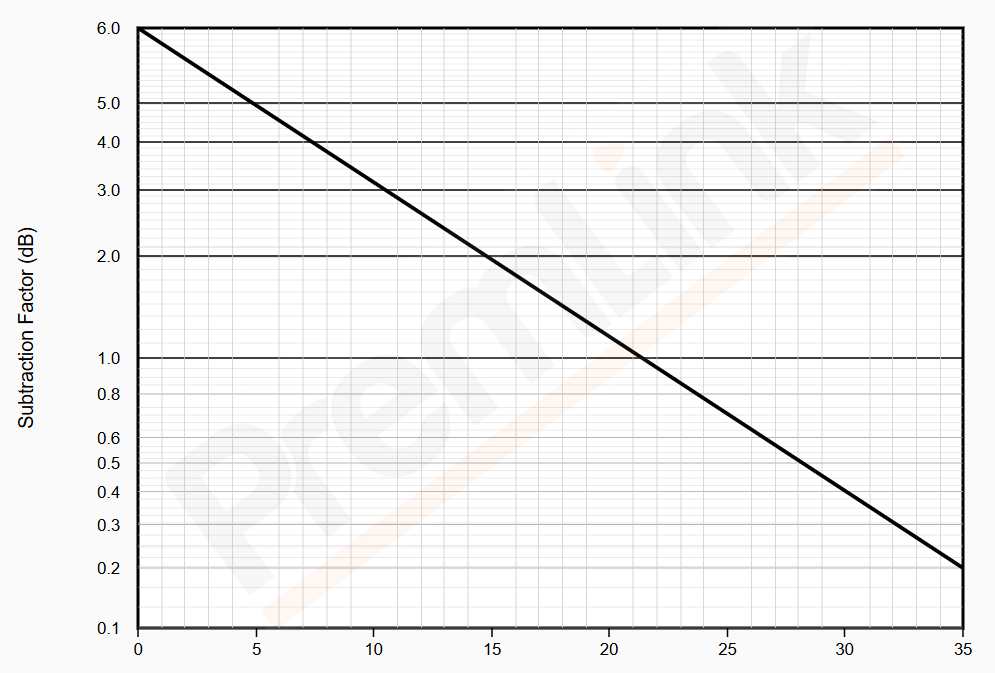
In a real-world hybrid environment where you might integrate a Premlink transmitter with legacy amplifiers from other vendors, the ratios are rarely identical. In these cases, you must use the power-of-ten summation for dissimilar CTB figures:
CTBs = -20 log₁₀ [ 10(-CTB₁/20) + 10(-CTB₂/20) + … + 10(-CTBₙ/20) ]
Optimization Strategy: The 2-for-1 Improvement Rule
When field measurements show a failing CTB (typically anything below 52 dB for a high-quality link), the most immediate and effective solution is managing the RF output levels. Extensive factory testing by Premlink engineers confirms a reliable “2-for-1” relationship: By reducing the amplifier’s output level by just 1 dB, you will typically improve the CTB performance by approximately 2 dB. This adjustment allows technicians to “fine-tune” a network to clear up distortion without having to re-engineer the entire fiber plant.
FAQ: Advanced Troubleshooting
Q: Why is CTB specifically a problem for digital QAM signals?
While legacy analog TV showed CTB as horizontal “beats,” digital QAM signals see it as a rise in the “intermodulation noise” floor. This kills the MER, leading to bit errors that manifest as tiling or frozen images on the subscriber’s set-top box.
Q: Can Cross Modulation (XM) be calculated using the same logic?
Yes. Cross Modulation—where the modulation of one carrier is physically imposed onto another—is also an odd-order distortion that adds on a voltage basis. Therefore, the 20 log rule and all CTB summation formulas apply identically to XM.
Q: What is the benefit of Premlink’s “High Linearity” design?
By utilizing premium internal gain blocks and advanced heat dissipation, Premlink edfa amplifiers maintain a linear response over a wider input range, ensuring that even under heavy channel loads, the CTB remains within carrier-grade specifications.