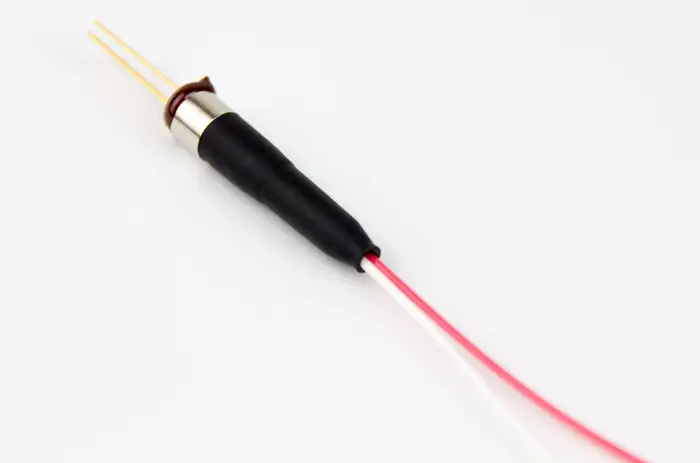
WDM Optical Receiver
Factory in China
Premlink plays a vital role in designing and manufacturing FTTH WDM Optical Receiver.
Need samples or custom designs?
Premlink – Your Professional WDM Optical Receiver Factory
Understanding the CATV Optical Receiver
CATV optical receiver is designed specifically for use in cable television HFC systems. An optical receiver’s key component is a pin diode, which converts the input optical signal into RF signals. When a optical signal is shined onto a Pin diode, photon energy is transformed to electron energy, resulting in an electric current.
The structure of a pin diode causes the current to be appropriate to the intensity of the received optical power, and it can receive optical signals of various frequencies and convert them into an equivalent electrical signal.
CATV optical receiver converts the optical fiber signal into an electrical signal and performs signal processing (e.g., amplification, filtering) to improve signal quality and stability for normal television playback. The processed signal is then distributed to multiple end users.
CATV optical receivers exhibit great sensitivity, low noise, and outstanding stability. It can accept weaker optical signals and convert them into stable electrical signals for output. These properties have resulted in a widespread use of cable TV receivers in cable television systems.
What Makes a WDM Optical Receiver Different?
WDM Optical Receiver is the CATV optical receiver integrated FWDM with an InGaAs pin diode. This FWDM + pin diode can transfer 1550nm CATV signal into an elecrtoric RF signal to TV and pass through GPON or XGSPON signal to xPON ONU.
Premlink, the leading WDM optical receiver factory in China, is engaged in the design and manufacturing of all kinds of WDM optical receivers in its long hisotry.
Premlink WDM Optical Receiver Product Series
WDM Optical Receiver vs. Optical Receiver without WDM
Block Diagram Comparison (Using PL150D as an Example)
The WDM Type (with Integrated FWDM)
The WDM type is currently a very popular device which integrates FWDM components internally in Pin Diode. This FWDM component splits the 1550nm signal for RF and passes through 1310/1490nm or/and 1270/1577nm for xPON (GPON or/and XGSPON) services.
It has two optical connection interfaces, one for connecting combined optical signals and the other for connecting PON signals.
The WDM Type (with Integrated FWDM)
No WDM type, as the name suggests, does not have WDM components, which means it is a regular typical optical node/receiver with wavelength window of 1100nm ~ 1600nm.
The other one is that the receiver blocks PON signals. As it may receive COM optical signals, which contain the PON wavelength of 1490nm, it interferes with 1550 signals. By filtering out PON signals and directly receiving 1550nm signals, the quality and stability of the signals are ensured.
The integration of FWDM into the optical receiver is an important component in the success of modern FTTH deployments. Combining a 1550nm CATV RF overlay with existing GPON/XGSPON data services on a single fiber means that video doesn’t need its own fiber infrastructure.
This “triple-play over one fiber” method makes it much cheaper and easier for operators to set up. Premlink’s WDM receivers are built with high-isolation FWDM to make sure that the strong 1550nm analog signal doesn’t t with the sensitive digital PON signals (1310/1490/1270/1577nm). This makes sure that both video and data services work perfectly at the same time.
Comprehensive Customization Services from Premlink Factory
Solutions for Network Requirements
Premlink, the top WDM optical receiver factory, provides a number of customization services for WDM optical receivers, including plastic and aluminum housing, varied output levels at 76 / 85 / 90dBuV, built-in ATT or EQ, small or medium size, and module or stand-alone configuration. Furthermore, our WDM optical receivers are designed for simple, quick, and convenient installation. Our SOP guide the manufacturing process for our optical receiver, which is subjected to strong inspection to assure the highest level of quality.

Key Application: Triple-Play Networks
CATV WDM Optical Receiver Applications
The WDM optical receiver is widely used in Triple-play networks (CATV+ Internet Data+ VoIP) to receive and convert TV broadcasting signals supplied via optical fibers into electrical signals for further signal processing and distribution, to pass through Internet Data/VoIP to ONU at end user. See as below. As a WDM optical receiver factory, Premlink can provideb the full solution for this application.
Frequently Asked Questions about WDM Optical Receiver
The main benefit is that it can support triple-play services over a single fiber. A normal optical receiver only changes the 1550nm CATV signal. A WDM optical receiver has a FWDM filter that separates the 1550nm video signal (which is converted to RF for TV) from the data wavelengths (1310/1490/1270/1577nm for GPON/XGSPON). The data wavelengths are then sent to the ONU for internet and voice. You don't need a second fiber anymore.
Our WDM receivers are made to work with as many devices as possible. We have models that support GPON/EPON pass-through (1310/1490nm) and models that support XGSPON & GPON (Combo PON) pass-through (1270/1310/1490/1577nm). For specific options, please look at our PL150D, PL160A, PL170A, PL190A, and PL200A series.
es, of course. Customization is our strong suit because we are a direct factory. We can make the output level (76/85/90 dBuV), housing (plastic or aluminum, size), built-in attenuator/equalizer, and optical connector type exactly how you want them. Get in touch with us to let us know what you need so we can quickly check if it's possible.
As a wdm optical receiver factory, the sample orders for standard models like the PL150D series can usually be processed and shipped in 3 to 5 business days. The lead time for custom designs depends on how complicated they are.
he built-in FWDM works like a smart filter. It sends the 1550nm CATV signal to the internal pin diode, where it is converted to RF. At the same time, it lets the PON wavelengths (like 1490nm downstream and 1310nm upstream) pass through with little loss to a separate output port. This port connects directly to the subscriber's standard GPON or XGSPON ONU. This makes sure that both services can work on their own and without any problems.