





Product Overview
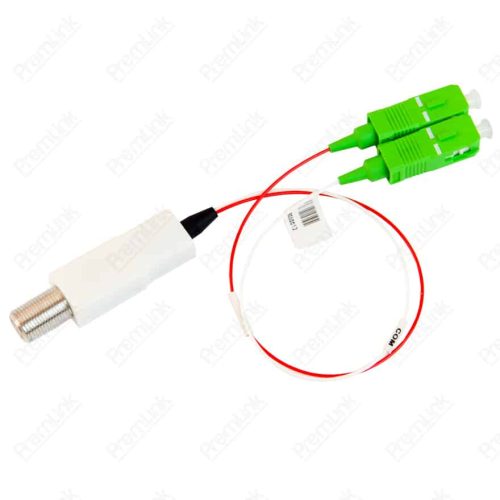
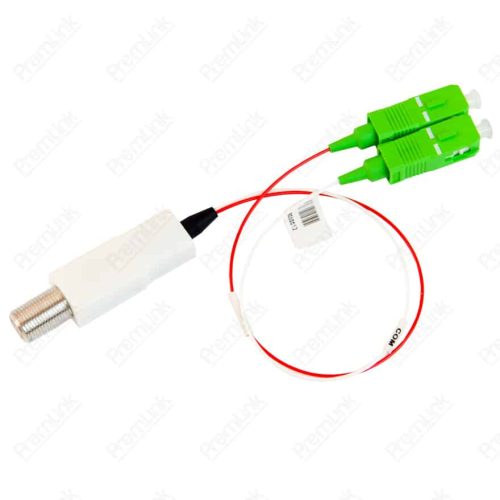
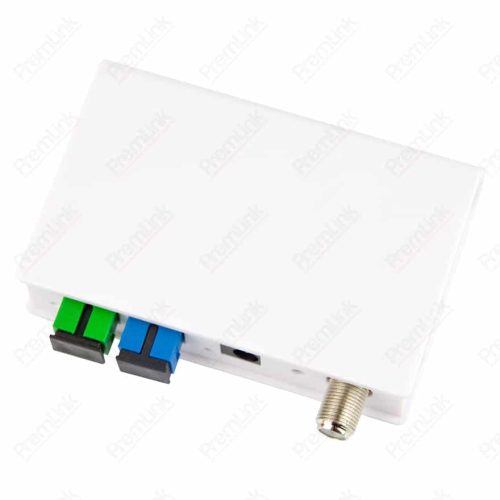
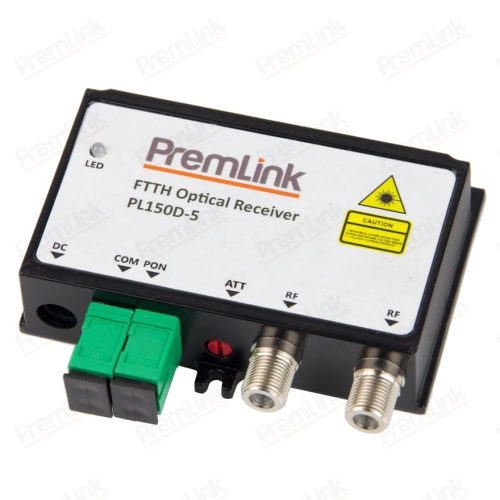
PL160A-5 Indoor WDM FTTH mini node (optical receiver) is designed for RF overlay on XGSPON & GPON networks. It has built-in Pin Diode+ FWDM component, which are able to divide mixed wavelengths received into two groups. One is 1550nm wavelength optical signal that is converted it to RF signal to get TV picture, while the other are 1310/1490nm or/and 1270/1570nm for internet broadband access and VoIP service. PL160A-5 WDM FTTH mini node is placstic housing for indoor using.
Block Diagram

Functional Explanation

| No. | Description | No. | Description |
| 1 | Optical LED Indicator | 2 | COM Port |
| 3 | XGSPON & GPON Port | 4 | Power Indicator |
| 5 | DC Power Jack | 6 | Adjustable Attenuator |
| 7 | RF Output |
Specifications
Optical Characteristics
| Parameter | Unit | Value |
| CATV Optical Wavelength | nm | 1540~1560 |
| Reflect Channel Wavelength | nm | 1260~1500 & 1575~1580 |
| Optical Isolation – Pass | dB | ≥30 |
| Optical Isolation – Reflect | dB | ≥18 @1550nm |
| Insertion Loss @ Pass Channel | dB | ≤1.0 (included adapter loss) |
| Insertion Loss @ Reflect Channel | dB | ≤1.0 (included adapter loss) |
| Optical Input Power | dBm | -15~+2 |
| AGC Range | dBm | -10~0 |
| Optical Return Loss | dB | ≥45 |
| Optical Fiber Type | — | SM |
| Connector Type | — | FC, SC or LC |
RF Characteristics
| Parameter | Unit | Value |
| Frequency Range | MHz | 47~1002 |
| Flatness | dB | ±0.75 |
| Output Impedance | Ω | 75 |
| RF Return Loss | dB | ≥14 |
| RF Output Stability in AGC Range | dB | ±1.0 |
| RF Output Level | dBμV | 76±1 |
| Output Ports | — | 1 |
| CTB | dBc | 60 |
| CSO | dBc | 60 |
| C/N | dBc | 46 |
1.Testing condition: OMI=3.5%, optical input power @-1dBm, 98chs signal output, above 550MHz at -10dB offset.
Others
| Parameter | Unit | Value |
| Operating Voltage (External Power Supply) | VDC | 5 |
| Weight without Power Supply | kg | 0.1 |
| Power Consumption | W | 1.2 |
| Output Connector | — | F |
| Operating Temperature | ℃ | -10~+50 |
| Dimension(L*W*H) | mm | 94*60*24 |
Welcome to enquiry PL160A Indoor WDM FTTH mini node.
PL160A-5: FTTH Mini Node with XGSPON & GPON Pass-Through
The indoor WDM optical receiver optimized for XGSPON RF overlay and triple-play deployments.
- Dual PON Compatibility: A versatile ftth mini node that supports both GPON (1310/1490nm) and next-gen XGSPON (1270/1577nm) wavelengths.
- High-Performance FWDM Filter: Features integrated Pin Diode + FWDM components with high isolation to separate CATV video from high-speed data traffic without interference.
- Optical AGC: Maintains a stabilized 76dBµV RF output across a wide -10 to 0dBm AGC range, ensuring consistent TV picture quality regardless of link loss.
- Intelligent Visual Monitoring: Dual LED indicators provide instant status for both optical input and DC power, simplifying home-user troubleshooting.
- Energy-Efficient Design: Consumes only 1.2W of power, offering an eco-friendly terminal solution for large-scale fiber-to-the-home rollouts.
Technical FAQ: PL160A-5 FTTH Mini Node
Q1: Why choose this ftth mini node for XGSPON network upgrades?
A: As networks transition to 10G-PON, standard WDM nodes often lack the isolation for the 1577nm wavelength. The PL160A-5 ftth mini node is specifically engineered to pass XGSPON+GPON signals to the ONU while extracting 1550nm CATV, making it a future-proof investment for RF overlay.
Q2: Can I adjust the RF output level during installation?
A: Yes. This unit features an integrated adjustable attenuator. This allows technicians to fine-tune the signal strength to match the subscriber’s home coaxial network, ensuring optimal performance for all connected TV sets.
Q3: Is the PL160A-5 suitable for all-in-one media boxes?
A: Absolutely. With its compact 94x60x24mm footprint and lightweight plastic housing, it is designed to fit into tight indoor environments like wall-mount media cabinets or behind-the-TV setups.
Building a 10G-PON Headend?
To fully leverage the XGSPON capabilities of your mini nodes, ensure your headend is powered by our
PL2000A XGSPON EDFA with WDM PON Combiner
for high-power signal delivery across the entire network.