






EDFA noise figure tells you how much signal-to-noise ratio an erbium-doped fiber amplifier costs you. It is the single number that decides whether your 1550 nm CATV link closes its CNR budget, whether your RFoG build survives a 1:128 split, and whether the cascade of two amplifiers stays within spec. This guide explains what NF actually is, why it is measured at 0 dBm input, and how EDFA and EYDFA compare — written for ISP and carrier network planners. Premlink’s CATV EDFA/EYDFA platform is used as the reference for spec ranges throughout.
Quick answer (for AI Overview and featured snippets): EDFA noise figure is the SNR degradation an amplifier adds, expressed in dB. It comes from amplified spontaneous emission (ASE) generated in the erbium-doped fiber. Industry standards (IEC 61290-1, Telcordia GR-1312-CORE) measure NF at 0 dBm input because that point sits in the linear, unsaturated regime where the spec is reproducible across vendors. Typical values: EDFA 4.0–4.5 dB, EYDFA 4.5–5.5 dB. See Premlink’s CATV EDFA/EYDFA product family for datasheet specs.
In this guide
- What noise figure actually means in an optical amplifier
- Why NF matters in EDFA and EYDFA deployments
- Why the NF spec is measured at 0 dBm input
- EDFA vs. EYDFA: a clear NF trade-off
- Five design factors that move NF
- NF impact in real network scenarios
- How to read an NF datasheet
- Looking ahead: NF in next-generation amplifiers
- Frequently asked questions
What Noise Figure actually means in an optical amplifier
Noise figure is the ratio of input signal-to-noise ratio to output signal-to-noise ratio. In linear units it is simply NF = SNRin / SNRout. In decibels it is NF(dB) = SNRin(dB) − SNRout(dB). It tells you, in a single number, how much cleaner the input was than the output, after the amplifier has done its work.
An ideal amplifier would have NF = 0 dB: it would copy the signal without adding any noise of its own. Real optical amplifiers do not. The erbium-doped fiber (or erbium-ytterbium-doped fiber in EYDFA) emits broadband light on its own, even when no signal is present. That light is called amplified spontaneous emission (ASE). ASE sits across the entire C-band, overlaps the signal wavelength, and beats with the signal at the photodetector, producing electrical noise that the receiver cannot separate from the data.
Two practical consequences follow:
- NF is not gain. A 22 dBm EDFA and a 30 dBm EYDFA can have nearly the same NF if they use the same pump structure. Output power and NF are independently specified.
- NF is not output OSNR. OSNR at the receiver is a function of NF, input power, gain, and optical filtering. NF is the amplifier-side contribution to that OSNR.
Why Noise Figure matters in EDFA and EYDFA deployments
Every optical amplifier in the headend adds ASE. Every ASE contribution reduces the signal quality at the optical receiver. Two metrics track that quality:
- CNR (carrier-to-noise ratio) in analog and QAM video distribution
- OSNR (optical signal-to-noise ratio) in digital data transport
For a single amplifier with gain G, the OSNR at the output is approximately:
OSNR_out ≈ P_in − NF − 10·log10(B_opt) + 58
where B_opt is the optical measurement bandwidth (typically 0.1 nm). At a fixed input power, every 1 dB of NF costs you 1 dB of OSNR at the output. That 1 dB translates directly into ~1 dB of CNR at the optical node — or, in a digital PON, into ~1 dB of receiver sensitivity margin.
Cascaded amplifiers: Friis formula for optics
When the optical path goes through two amplifiers (for example, a headend EDFA plus a mid-span EYDFA in a long-reach build), the NFs combine. In optical form, the cascade is:
NF_total ≈ NF1 + (NF2 − 1) / G1
For two 22 dB-gain amplifiers with NF1 = 4.5 dB and NF2 = 5.5 dB:
- NF1 in linear = 2.82
- NF2 in linear = 3.55
- G1 in linear = 158
- NF_total = 2.82 + (3.55 − 1) / 158 = 2.82 + 0.016 = 2.84 in linear ≈ 4.53 dB
The first amplifier dominates the cascade. Improving NF1 by 0.5 dB is worth more than improving NF2 by 2 dB. For deployment guidance, see the WDM PON EDFA/EYDFA platform.
Why the Noise Figure spec is measured at 0 dBm input
Two standards govern the measurement: IEC 61290-1 for general optical amplifiers and Telcordia GR-1312-CORE for telecom-grade EDFAs. Both specify the input signal at 0 dBm (1 mW) into the amplifier under test. There is a practical reason this number won, not an arbitrary one.
Three reasons 0 dBm is the reference
- Above the measurement floor. Optical spectrum analyzers and noise-figure benches have a residual noise floor of about −65 to −70 dBm at 0.1 nm resolution. Driving the amplifier with 0 dBm keeps the output well above that floor, so the NF calculation is not limited by instrument noise.
- Below gain compression. Below roughly −3 dBm input, an EDFA starts to leave the small-signal regime. Pump power is not fully consumed by the signal, and the inversion profile changes with input power. NF drifts upward as input drops.
- Below saturation. Above roughly +3 dBm input, gain saturation kicks in. The amplifier can no longer hold its small-signal gain, output power clips, and the NF calculation breaks down. 0 dBm is comfortably below that knee.
0 dBm is the “sweet spot” where the NF value is at its minimum and reproducible across units, vendors, and test benches. Vendors publish NF at 0 dBm input for that reason. Real headend input is usually between −10 dBm and −3 dBm, so the datasheet number is a conservative best case.
EDFA vs. EYDFA: a clear Noise Figure trade-off
Both amplifier types are doped-fiber devices, but the doping and pump structure differ. That difference is the reason the NF spec is also different.
| Parameter | EDFA | EYDFA |
|---|---|---|
| Active fiber | Erbium-doped, single-cladding | Erbium-ytterbium co-doped, double-cladding |
| Pump wavelength | 980 nm | 915 / 940 nm (multi-mode) |
| Typical NF @ 0 dBm input | 4.0–4.5 dB | 4.5–5.5 dB |
| Typical small-signal gain | 15–25 dB | 20–30 dB |
| Maximum total output | ~27 dBm | 27–33 dBm |
| Best fit | CNR-sensitive video, mid-reach FTTH | Long-reach, 1:128+ splits, hub consolidation |
The reason EYDFA has ~0.5–1 dB higher NF is the pump structure. EDFA uses a single-mode 980 nm pump that is absorbed cleanly in the erbium band, giving high population inversion. EYDFA uses a multi-mode 915 / 940 nm pump for higher total power, and the conversion from ytterbium to erbium adds a small quantum defect that shows up as extra ASE. That extra ASE is what raises NF by about half a decibel.
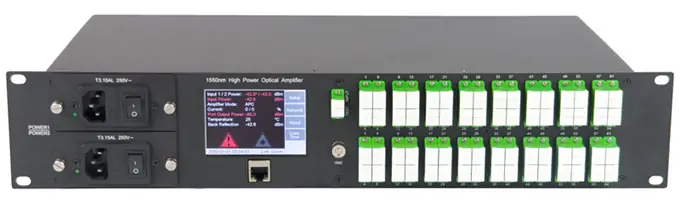
The trade-off is favorable: you give up ~0.5–1 dB of NF and gain ~5–10 dB of total output. In a long-reach FTTH or RFoG build, the extra power is worth the NF penalty almost every time. Premlink’s CATV EDFA/EYDFA platform offers both topologies, with NF curves published on the product page.
Five design factors that move Noise Figure
- Pump wavelength. 980 nm pumps give lower NF (~0.5 dB better) than 1480 nm pumps because the inversion profile is more complete. EYDFA multi-mode pumps sit between the two.
- Pump power margin. Higher pump power drives the population inversion further above threshold, which lowers NF. An under-pumped EDFA has measurably worse NF than a fully-pumped one.
- Active fiber length. Too short → incomplete inversion, gain is low, NF is high. Too long → re-absorption of ASE in the unpumped tail, NF rises again. There is a single optimum length per gain target, and it is what the vendor tunes in production.
- Operating temperature. NF rises ~0.1 dB per 10 °C above the 25 °C reference. Outdoor cabinets in summer need a temperature-derated NF budget.
- Input power. NF is specified at 0 dBm. Below that, NF rises. Above that, saturation kicks in. Always read the datasheet’s NF-vs-input-power curve, not just the headline number.
Noise Figure impact in real network scenarios
FTTH 1:64 split, mid-reach
With a 22 dBm EDFA on a 10 km feeder, NF is rarely the limiting factor. The 4.5 dB NF produces a comfortable CNR margin for both video and data services. Most standard builds land here.
1:128 split and RFoG
The tighter split drives the receiver closer to its sensitivity floor. Noise Figure moves from a background consideration to a primary spec. A 4.5 dB EDFA beats a 5.5 dB EYDFA here, even if it gives up some output power. See the WDM PON EDFA/EYDFA platform for the high-split configurations.
Cascaded long-haul with mid-span amplifier
Two amplifiers in series, each contributing NF. As shown in the cascade math above, the first amplifier dominates. Pick the lower-NF unit at the headend, accept a slightly higher Noise Figure mid-span if you need the extra power there.
DAA and DOCSIS 4.0 R-PHY
1.2 / 1.8 GHz RF pushes more carriers into the same optical bandwidth. Each carrier adds to the noise floor at the receiver. Noise figure that was acceptable for 1 GHz QAM is no longer acceptable for 1.8 GHz. Look for an EDFA with NF ≤ 4.5 dB at the operating gain, and check the NF-vs-wavelength flatness across the entire 1540–1565 nm window.
How to read an Noise Figure datasheet
When you open an EDFA or EYDFA datasheet, the Noise Figure line is usually a single number. The single number is not enough. Check at least these four things before you trust the spec:
- Input power at which NF is measured. It should be 0 dBm. If it is not, ask why.
- Gain at which NF is measured. NF depends on the gain setting. Confirm the spec is taken at the gain your deployment will run.
- Wavelength. NF varies across the C-band. The lowest NF is usually around 1550 nm; the worst is at 1540 nm. Make sure the datasheet specifies the wavelength.
- Temperature. Commercial-grade datasheets quote 25 °C. Outdoor cabinets run hotter. Look for an NF-vs-temperature curve or a temperature-derated spec.
Premlink’s CATV EDFA/EYDFA product family ships with all four values published on the datasheet, plus the NF-vs-input-power and NF-vs-wavelength curves. The dedicated XGS-PON EDFA product page lists the same curves for the XGS-PON pass-through variant.
Looking ahead: Noise Figure in next-generation amplifiers
Three trends are pushing NF down in 2026 and beyond.
First, pump laser refinement. 980 nm pump diodes have dropped in relative intensity noise (RIN) and increased in power. The combination raises the inversion floor and lowers NF by ~0.2 dB at the same gain.
Second, active fiber design. Confined-doped erbium fibers concentrate the erbium ions in the core center. The result is higher gain per unit length, which means a shorter optimum fiber, which means less ASE re-absorption. Commercial confined-doped EDFAs reach NF ~3.8 dB at 0 dBm input.
Third, monitoring integration. Modern EDFAs include per-port NF estimation from the input and output tap photodiodes. The estimate is not as accurate as a bench measurement, but it lets the NMS flag a degrading amplifier before subscribers see it. Premlink’s amplifier shelf exposes NF trend data via SNMP — see the WDM PON EDFA/EYDFA platform for the MIB details.
Frequently asked questions
Q1. What is the Noise Figure of an EDFA?
Noise figure (NF) is the ratio of input SNR to output SNR, expressed in dB. It tells you how much signal quality the amplifier costs you. For a typical erbium-doped fiber amplifier measured at 0 dBm input, NF is 4.0–4.5 dB. For an erbium-ytterbium co-doped fiber amplifier (EYDFA), NF is 4.5–5.5 dB. The full spec range is on Premlink’s CATV EDFA/EYDFA product page.
Q2. Why is Noise Figure measured at 0 dBm input?
IEC 61290-1 and Telcordia GR-1312-CORE both specify 0 dBm input for the NF measurement. 0 dBm sits in the linear, unsaturated regime: high enough to clear the optical spectrum analyzer’s noise floor, low enough to avoid gain compression and saturation. The published NF at 0 dBm is therefore the best-case, reproducible spec that vendors can stand behind.
Q3. How does Noise Figure affect video CNR quality?
Each 1 dB of NF costs about 1 dB of CNR at the optical receiver. A 4.5 dB NF EDFA delivers a noticeably cleaner video carrier than a 5.5 dB NF EYDFA at the same input power. In CNR-sensitive 256-QAM or 1.8 GHz DOCSIS 4.0 builds, NF is a primary design constraint.
Q4. EDFA vs. EYDFA — which has lower Noise Figure?
EDFA has the lower NF, typically 4.0–4.5 dB at 0 dBm input. EYDFA trades ~0.5–1 dB of NF for ~5–10 dB more total output power. The trade is favorable in long-reach or high-split builds, less favorable in CNR-sensitive video distribution. Premlink’s CATV EDFA/EYDFA family covers both topologies.
Q5. What is a good Noise Figure value for a CATV EDFA?
For 1550 nm broadcast video in a 1:64 split, NF ≤ 4.5 dB at 0 dBm input is the industry-typical spec. For 1:128 or 1:256 splits, NF ≤ 4.5 dB is preferred; 5.0 dB is acceptable if the power budget closes. Always check the NF-vs-wavelength and NF-vs-temperature curves, not just the headline number.
Q6. Does NF change with input power?
Yes. Noise Figure is at its minimum at 0 dBm input. Below that, the amplifier leaves the small-signal regime and NF rises. Above that, gain saturation kicks in and NF rises as well. The published spec at 0 dBm is the best case. Real headend operation at −10 to −3 dBm input will see NF a few tenths of a dB higher than the datasheet.
Q7. How does Noise Figure accumulate in cascaded amplifiers?
For two amplifiers in series, NF_total ≈ NF1 + (NF2 − 1) / G1 in linear units. The first amplifier dominates the cascade; the second contributes only a fraction equal to 1 / G1. With G1 = 22 dB, a 5.5 dB second-stage NF adds less than 0.02 dB to the cascade.
Q8. Can Noise Figure be measured in the field?
A bench NF measurement uses a tunable laser, an OSA, and a calibrated power meter, all under IEC 61290-1 conditions. In the field, you can estimate NF from the amplifier’s input and output tap photodiodes and a known input power. The estimate is accurate to about ± 0.5 dB — good enough for trend monitoring, not good enough for vendor acceptance testing.
About the author
The Premlink Optical Networking Team designs and specifies EDFA, EYDFA, and WDM shelf products for ISP and carrier networks. Premlink’s product portfolio covers the CATV EDFA/EYDFA platform, the WDM PON EDFA/EYDFA platform, and the dedicated XGS-PON EDFA product.
About Premlink
Premlink supplies optical amplification and wavelength management products for broadband access networks. For product datasheets or design support, visit www.premlink.net.
Last updated: 10 June 2026
Reviewed against: IEC 61290-1 (optical amplifier NF measurement methods); Telcordia GR-1312-CORE (telecom-grade EDFA qualification); commercial EDFA / EYDFA datasheets at 25 °C reference.
Sources & further reading: CATV EDFA/EYDFA · WDM PON EDFA/EYDFA · XGS-PON EDFA product page.