






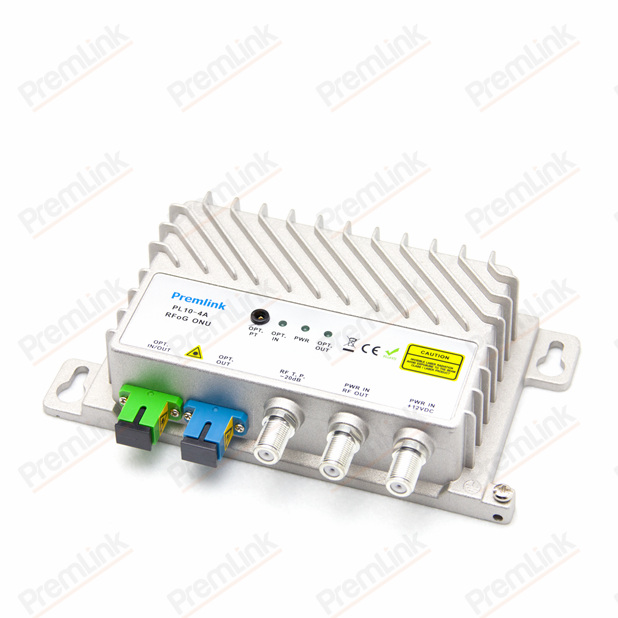

产品概述
PL10-6A RFoG 微节点如下 SCTE 174 2010 标准。(光纤到户射频传输)。PL10-6A RFoG 微节点提供不同的频率分割选项,例如 42/54MHz、65/86MHz 和 85/105MHz。PL10-4A 的工作带宽为 1002MHz,另有 1218MHz 带宽可用于 DOCSIS 3.1 应用。PL40-6A RFoG 微节点支持 1GPON+10GPON 直通传输。.
功能解释
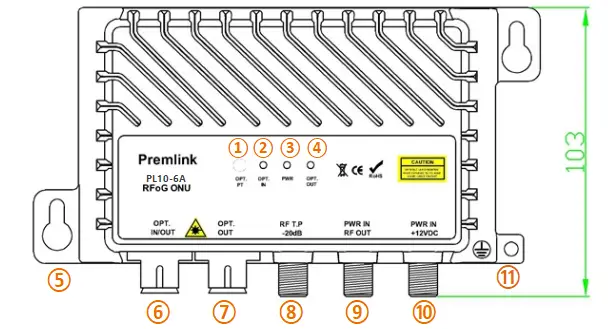
PL10-6A RFoG 微节点
| 不. | 描述 | 不. | 描述 |
| 1 | 输入光功率测试端口:用于测试和验证输入光功率:1V/mW | 7 | XGSPON 和 GPON 直通端口 |
| 2 | 输入光功率指示灯:当输入功率在正常范围内时,指示灯亮起绿色 | 8 | 射频测试端口:正向输出电平测试,-20dB |
| 3 | 电源开/关指示灯 | 9 | 电源输入/射频输出端口:直流电源可通过电源端口或射频端口输入。 |
| 4 | 返回发射器电源指示灯:开启表示工作正常。. | 10 | 电源输入端口:+12~15V 直流输入 |
| 5 | 安装孔 | 11 | 接地 |
| 6 | 光纤输入/输出端口:插入带有 SC/APC 连接器的光信号电缆 |
技术规格
前进路径
| 参数 | 单位 | 值 | 健康)状况 | ||
| 光波长
(通行通道) |
nm | 1530~1565 | 典型值 1550nm | ||
| nm | 1600~1620 | 典型值 1610nm | |||
| 光波长
(反射通道) |
nm | 1260~1360 | λ = 1270/1310nm | ||
| nm | 1480~1550 | 典型值 1490nm | |||
| nm | 1575~1580 | 典型值 1577nm | |||
| 隔离 | 反射通道 | dB | ≥30 | λ = 1550/1610nm | |
| 通通道 | dB | ≥30 | λ = 1270/1310/1490nm | ||
| dB | ≥28 | λ = 1577nm | |||
| PON插入损失 | dB | ≤1.5 | |||
| 监测电压 | 伏/毫瓦 | 1 | λ=1550nm | ||
| 光输入功率 | dBm | -6~+2 | AGC范围 | ||
| *频率范围 | MHz | 54~1002/1218 | *42/54、65/86、85/105MHz 可用 | ||
| 平坦度 | dB | ±0.75 | |||
| *坡 | dB | 5±1 | 3±1 个可用 | ||
| 输出收益损失 | dB | ≥16 | |||
| 光输出回波损耗 | dB | 45岁以上 | |||
| *输出电平 | 分贝毫伏 | 18±2 | 36±2 | 1.(引脚功率=-1dBm,4% OMI/通道,79通道NTSC,550MHz以上的数字通道)
(-6dB偏移) 2.(Pin=-1dBm,4% OMI/通道,42通道 CENELEC) |
|
| 分贝毫伏 | 78±2 | 96±2 | |||
| *C/N | dB | 51 | |||
| *CTB | dB | ≤-65 | |||
| *首席战略官 | dB | ≤-60 | |||
| 等效噪声输入 | pA/Hz | <7 | |||
返回路径
| 参数 | 单位 | 值 | 健康)状况 |
| 波长 | nm | 1600~1620 | CWDM可用 |
| 光学输出功率 | mW | 1~3 | 典型值 2mW (3dBm)。 |
| *射频输入电平 | 分贝毫伏 | 20~40 | 典型的 |
| 分贝毫伏 | 80~100 | ||
| 平坦度 | dBm | ±0.75 | |
| 输入收益损失 | dB | ≥16 | |
| 光输出回波损耗 | dB | 45岁以上 | |
| *光学激光开启水平仪 | 分贝毫伏 | 15 | 客户请求已满足 |
| 分贝毫伏 | 75 | ||
| *光学激光关闭水平仪 | 分贝毫伏 | -4 | 客户请求已满足 |
| 分贝毫伏 | 56 | ||
| 激光升空时间 | ms简体中文(大陆) | ≤1.3 | |
| 激光坠落时间 | ms简体中文(大陆) | ≤1.6 |
其他
| 参数 | 单位 | 值 | 健康)状况 |
| 电压 | 直流电压 | 12 | 100~230V 电源适配器 |
| 功耗 | W | < 5.5 瓦 | 随附电源适配器 |
| 工作温度 | ℃ | -20~55 | 湿度 5~95%,无冷凝 |
| 光连接器 | / | SC/APC | 客户请求已满足 |
| 射频连接器 | / | F | |
| 尺寸 | mm | 172*103*41 | |
| 重量 | 千克 | 0.4 |
我们的 RFoG 微节点提供与 DOCSIS 网络相同的服务,并具有更好的噪声性能和在下行路径和返回路径方向上增加可用射频频谱的额外优势。.
PL10-6A:具有 XGSPON 和 GPON 直通功能的 RFoG 微节点
适用于融合 10G-PON 和 DOCSIS 3.1 网络的 RF over Glass (RFoG) 解决方案,确保平滑演进至超宽带。.
- 普遍的PON共存: 本款 rfog 微节点 它集成了一个高隔离度的WDM滤波器,可以透明地通过两者。 GPON(1490/1310nm) 以及 XGSPON(1577/1270nm) 向联合国发出信号。.
- DOCSIS 3.1 全光谱: 针对下一代性能进行了优化,工作带宽高达 1218MHz, 为视频、语音和高速数据传输提供平台。.
- 符合 SCTE 174 标准: 已启用 连发模式 抑制上行噪声并减少密集型 FTTH 网络中的光拍干扰 (OBI)。.
- 高增益射频输出: 可提供高达 的稳定输出水平 96dBµV 通过集成 光学自动增益控制 (-6 至 +2dBm),在可变光纤链路预算下保持信号完整性。.
- 双工滤波器分割: 支持全球运营商标准,提供多种频率分割选项,包括 42/54MHz、65/86MHz 和 85/105MHz……以实现上行/下行灵活性。.
技术常见问题解答:PL10-6A RFoG Micronode
Q1:rfog 微节点如何同时支持 GPON 和 10G-PON?
答: 该 PL10-6A rfog 微节点 配备三波长 WDM 滤波器。它提取 1550nm CATV 信号进行射频转换,同时将 1260-1360nm 和 1480-1580nm 光谱(涵盖 GPON 和 XGSPON 波长)以超低插入损耗 (≤1.5dB) 传输到 PON 端口。.
Q2:-20dB射频测试端口对技术人员有什么好处?
答: 集成 -20dB射频测试端口 无需断开用户家庭网络即可进行实时信号验证。技术人员可以测量前向输出电平和倾斜度,确保 1.2GHz DOCSIS 3.1 信号在接入点处完全平衡。.
Q3:突发模式如何降低 10G-PON 叠加网络中的 OBI?
答: 通过使用快速响应激光驱动器(上升/下降时间≤1.6ms), rfog 微节点 仅当电缆调制解调器发送数据突发时,才会激活其回传发射器。这大大减少了回传光纤上的活动激光器数量,这对于在高分光比 XGSPON 环境中防止光干扰至关重要。.
想让您的HFC网络现代化吗?
对于高密度城市部署,如果 10G-PON 和 RF 叠加网络共存,则应将以下两种方案配对使用: PL10-6A 与我们的
高功率 XGSPON EDFA 合路器
为用户提供无 OBI、高带宽的用户体验。.


